1. The significance of the first drinking of laying chicks at the age of 1 day
The first drink of 1-day-old laying chicks is called the first drink. The water in the chicks that are transported over long distances after hatching consumes a lot of water, so they should drink water before eating. This can promote intestinal peristalsis, absorb residual egg yolk, discharge meconium, increase appetite, reduce stress and infection, replenish water, and restore physical strength. Insufficient drinking water for laying chicks in the first 3 days, especially the lack of drinking water for laying chicks in the first day, can easily lead to dehydration death or delayed feeding in the 3rd to 5th days, resulting in a decrease in the uniformity of the flock and affecting growth and later laying performance.
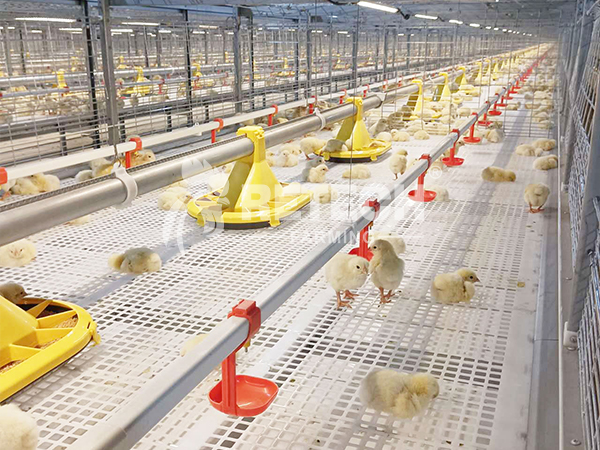
broiler poultry in the Philippines
Some large-scale professional brooding companies or large-scale laying hen breeding companies have a large number of single batch brooders. They use a small water bottle to manually add water in the first 7 days, and add water every 2 hours. Due to the heavy workload of the breeders, the long drinking time of the drinking fountains, the difficult to grasp the water quality, and the troublesome cleaning, many companies try to drink directly with nipples at the age of 1 day.
2. 5 prerequisites for direct nipple drinking at the age of 1 day
- The chicks should be strong and uniform
Breeder chickens are equivalent to the mature age of humans at 200-300 days of age, and the body is relatively stable in all aspects. The quality of the breeding eggs in this range is relatively stable, the chicks are strong, and the nipples are strong.
The chicks hatched by small breeders are small, and there may be a certain proportion of small or weak chicks. If you use the nipple to drink water directly, it may cause the chick to fail to find the nipple or talk about the nipple insufficiently, and thus cannot drink or drink less water, delaying food intake. Dehydration occurred after 3 days, resulting in high pre-mortem and poor uniformity of the flock. - Avoid stress
Mainly high temperature stress. In summer, it is especially difficult to lower the temperature of some poorly-conditioned chicks. Long-distance transportation combined with high temperature in some chicken houses accelerates the dehydration of the chicks, resulting in excessive physical exertion and weak nipples, or the nipples are not strong enough to drink water. Or the drinking water is too little, which affects the feeding, causing dehydration and death of chickens after 3 days, and the uniformity of the large group decreases. - 1-day-old chicks with beaks cut off are not suitable for nipple drinking
At present, more and more incubators are starting to use the one-day-old beak cutting technology. While bringing convenience to the farm, the chick’s nipples may have a certain impact. Traditional nipples have a greater impact on it, resulting in not dare to talk about nipples or babbling less frequently, resulting in inadequate or insufficient drinking water, which affects food intake, which leads to dehydration after 3 days, high death scouring, and uniformity of large groups. - Use professionally matched chick nipple drinkers
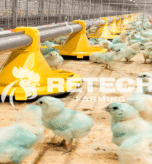
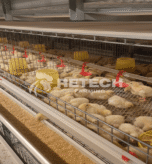
The height of the nipple can be adjusted, and the water pressure can also be adjusted. Slowly adjust the pressure and height as the child ages. Adjust the nipple drinking system for 0 to 3 days, so that a drop of water hangs on the nipple to help the chicks find a source of water. Splashing water in the water cup is very useful for brooding and hot days. The 360degree nipple drinker can help chicks drink more easily. The 360degree nipple drinker is necessary for chicks that are beaked in the hatchery.0~3 days, the water cup needs to be filled manually to train the chicks to drink. Open drinking fountains, the sink is easy to be contaminated and need to be cleaned daily. - Pay attention to waterline cleaning every day
The temperature in the brooding house is generally high. During the brooding process, some friends like to use some multi-dimensional, glucose, open medicine and other drinking water, which can easily cause bacteria to multiply, and biofilm grows in the tube wall. Pay attention to flushing the pipelines and nipples every day to keep drinking water. Cleanliness and hygiene.
The above are the five key points and prerequisites for directly using nipple drinking water. If you are not sure, the best suggestion is to use a small water bottle for 1 week, then transition to nipple drinking for 3 days, and transition to nipple drinking on the 10th day. For several days, closely observe the drinking status of the chickens until they are normal.
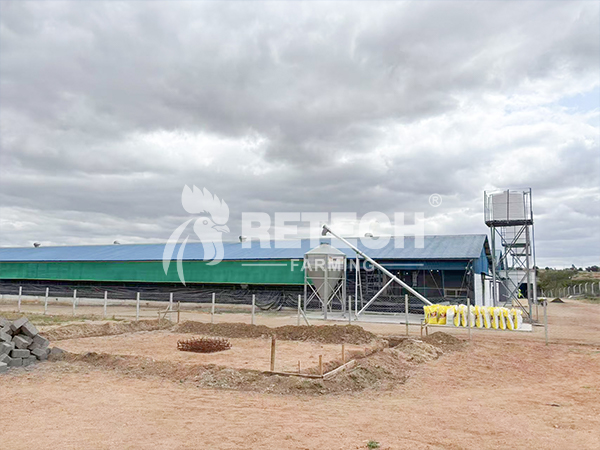
pullet poultry cage
Large-scale enterprises recommend using a kettle for at least the first 3 to 4 days. At the same time, use it with the nipple, then slowly remove the small water bottle and replace it with a nipple. Observe the large group of drinking water until the chickens are used to nipple drinking.
Some farms may cut their beaks by themselves in 7-9 days. The beaks of the chickens are sore just after the cut, and the number of chicks chatting on the nipples is reduced. In this case, it is recommended to use the small water bottle for a few more days. After a transition period of 3 to 4 days, allow the chickens to adapt, and then use the nipples for drinking. Closely observe the drinking water condition of the flock until it is normal.
In addition, in the summer high temperature season, after the chicks enter the house, if there is dehydration, immediately boil water. Note that you must use a kettle to drink water, in addition to wet mixing materials, and stress relief products to supplement the body’s loss of water, reduce dead scouring, and reduce losses.
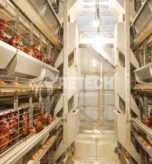
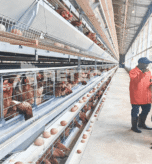
How to Choose Brooding Cage Equipment? Expert Guide
1. Equipment Material: Prioritize stainless steel or galvanized steel, which is corrosion-resistant, rust-resistant, and can withstand high humidity environments, ensuring the hygiene and safety of chicks. Inferior plastics are prone to deformation, affecting service life.
2. Scientific Stocking Density: Customize solutions based on your farming scale and batch size. Properly plan the cage size and number of layers to ensure chicks have sufficient space to move around and a comfortable temperature, avoiding overcrowding and stress.
3. Integrated Automation System: Modern brooding cages should be equipped with automatic feeding, watering, and temperature control systems. PLC-controlled ventilation and heating modules can monitor the temperature in real time (ideally 35-38℃), reducing manual intervention and increasing survival rates by over 20%.
RETECH is a poultry farming equipment manufacturing expert. We provide customized solutions, and automated brooding cages help achieve efficient brooding.